

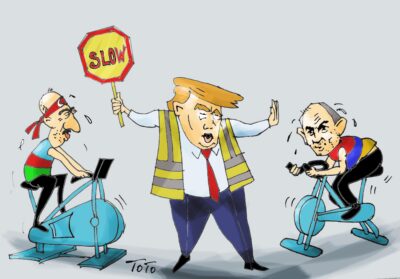
In recent months, a clear slowdown has been noticed in the process of normalizing Armenian–Turkish and Armenian–Azerbaijani relations. It has reached a point where the parties themselves openly state that no meaningful progress can yet be recorded and that moving forward remains difficult. Although Armenia’s foreign minister has stated that the intensity of Armenian-American contacts regarding the Trump Route for International Peace and Prosperity (TRIPP) project has not decreased, he did not in any way address the timeline for the implementation of the project’s construction work. In his turn the speaker of the Armenian parliament stated that Turkey is effectively hostage to Azerbaijan’s influence when it comes to normalizing relations with Armenia. Despite this, he also expressed the view that the opening of the borders is approaching; however, it is still unclear whether they will be fully opened or only for third-country citizens and goods.
So, the process has effectively linked the normalization of Armenian–Azerbaijani relations exclusively to the implementation of the TRIPP project, while Turkey, in turn, conditions the normalization of Armenian–Turkish relations on progress in Armenian–Azerbaijani relations. As a result, a chain of three interconnected processes has been formed: the implementation of the TRIPP project, Armenian–Azerbaijani relations, and Armenian–Turkish relations. These have become an interdependent package, where the failure of any one element directly affects the others.
At present, there is no significant progress on the TRIPP project, which also implies a slowdown in the other processes. The prospects for the project’s implementation are partly dependent on Iran–US relations. During the recent war, Iran repeatedly demonstrated its ability to strike not only military but also economic American initiatives in the region, including TRIPP. Therefore, the implementation of the project now depends not only on the United States but also on Iran.
As for Azerbaijan, if TRIPP is not implemented for various reasons, Baku will naturally return to its “Zangezur corridor” agenda. Regardless of whether it is called TRIPP or the “Zangezur corridor,” its strategic objective will remain the same, although the framing will differ. Thus, the following logic emerges: without TRIPP, it is difficult to imagine progress in Armenian–Azerbaijani peace and Armenian–Turkish normalization. If TRIPP is not implemented, the likelihood of alternative and more risky scenarios increases.
The absence of viable alternatives reflects yet another challenge for Armenia. It has become extremely complicated to involve third-party mediators in this issue if the TRIPP process fails. It is difficult to imagine how third countries could mediate the normalization of Armenian–Turkish and Armenian–Azerbaijani relations, not only because Washington has historical experience in this matter, but also because others are constrained.
For example, Russia is unlikely to take on such a role given its relations with Azerbaijan, and France faces similar limitations. Turkey cannot serve as a mediator due to its lack of neutrality, while China does not have sufficient influence over both parties to play that role effectively. As a result, the issue of finding a mediator becomes even more complex, especially considering that, as noted, Armenia has very limited alternatives and is largely left relying on Trump and the project he has proposed.
In this situation it cannot be ruled out that Moscow may take the initiative and push forward the agreement signed on November 9 under its auspices. However, this would require substantial effort from Moscow, particularly in terms of stabilizing its relations with Azerbaijan. The European Union is also unlikely to serve as an effective mediator, given its limited influence over the parties, especially Azerbaijan.
Therefore, at present, it is difficult to imagine a more realistic and effective mediator than the United States and the Trump administration. Trump’s team will need to act cautiously, especially ahead of the midterm elections, and pursue a more nuanced approach in the South Caucasus while trying to demonstrate tangible results. After all, peace does not come simply by talking about it. Achieving peace requires first and foremost the signing of a formal peace agreement, one that the Trump administration would need to help facilitate.
The United States may indeed be the only viable mediator, yet its regional policy and the current state of its relations with Iran limit Washington’s ability to act more effectively on the TRIPP project. For Armenia’s security, it is natural to favor the rapid normalization of US–Iran relations. This would not only enable economic cooperation with Iran but also facilitate the implementation of the TRIPP project. However, there are still significant challenges that Tehran and Washington must overcome first, and so far they have not succeeded.
