

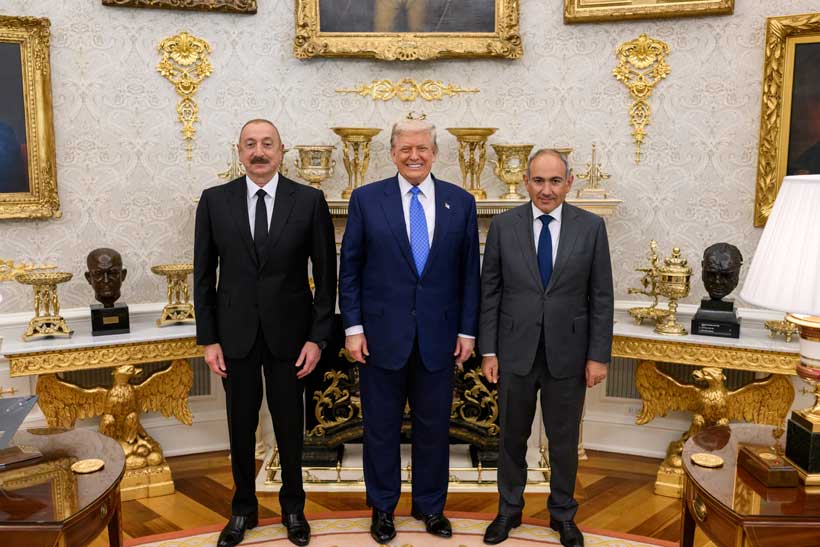
In recent days, the central topics of discussion in Armenia’s political sphere have been the agreements reached between Armenia and Azerbaijan with US mediation, the first anniversary of those agreements, and the phone conversation between the prime minister of Armenia and the presidents of the United States and Azerbaijan.
In fact, the Trump administration has achieved in the South Caucasus something that no previous US administration has managed to accomplish since 1991. This concerns the idea of connecting Central Asia to Europe through the South Caucasus and the Middle Corridor, as well as the prospect of integrating Armenia into global supply chains. The initiative has strategic significance for Washington because it creates uninterrupted transportation and communication routes that bypass Russia, China, and Iran. The concept itself is not new, but it has never before reached this stage of implementation.
It is clear that timing is a critical factor here, and the project must be implemented as quickly as possible. This is precisely why the role of Washington bureaucracy has been significantly reduced in this process. Every effort is being made to ensure that the project is launched as rapidly as possible and that no additional obstacles emerge within Washington’s administrative system that could affect the implementation timeline.
This applies both to the State Department, where decision-making processes can often be slow, and to the National Security Council, where decisions and policy scenarios may also take considerable time to develop. At the moment, these obstacles effectively do not exist. Both competing institutions are headed by Rubio, and, at least in the case of this project, decisions appear to be made rather quickly.
It is also important to address the appointment of Konstantin Sokolov, which generated a wide range of interpretations. His appointment should be viewed within the same strategic framework. Sokolov is quite familiar with Armenia’s business environment, including both its strengths and its weaknesses. More importantly, his appointment also fits the broader logic of reducing bureaucracy. He has direct connections with key figures in the Trump administration and, in the implementation of the Trump Route for International Peace and Prosperity (TRIPP) and the broader project, he will benefit from the administration’s immediate and unconditional support.
At present, the main factors complicating the TRIPP project are the railway issue and the tense US–Iran relationship. TRIPP is the American strategic project located closest to Iran’s border, with all the implications that entails. This may create certain concerns on the American side, particularly during the current period of heightened tensions, and could slow the implementation of the project.
At the same time, it is necessary to understand what may happen if TRIPP is not built, for a variety of reasons that may depend on the realities of our region, a US–Iran war, the domestic political situation in the United States, and other issues. What will happen to Armenia if the TRIPP project is not implemented?
Azerbaijan has declared repeatedly that, regardless of everything, it wants to have its own connection with Nakhichevan, and Armenia should provide it with a corridor to establish that connection, since the American initiative would otherwise not be possible to implement.
The second possible scenario is that Russia may try to become a mediator in this process, relying on the November 9, 2020 trilateral statement, according to which Russia undertook to ensure the connection between Azerbaijan and Nakhichevan through Armenian territory and to ensure its security.
Of course, other mediators may also emerge — countries that can exert influence over both Azerbaijan and Armenia. For example, Turkey or China may seek to act as mediators and implement the project themselves if, for whatever reason, the United States is unable to implement this project in the short term.
Overall, it appears that Washington is eager to move forward with the project as quickly as possible and within the shortest feasible timeframe.
The rationale is clear: the Trump administration wants to see the project implemented while both Iran and Russia remain preoccupied with their own challenges, and while Donald Trump is still president of the United States. For this reason, Washington will most likely double down on its efforts and devote even greater resources to advancing the project. It is likely that, in the coming period, clear signs of increased American activity will emerge, accompanied by a more concerted effort to bring the project to fruition.
Originally Published at the Armenian Mirror Spectator.
