

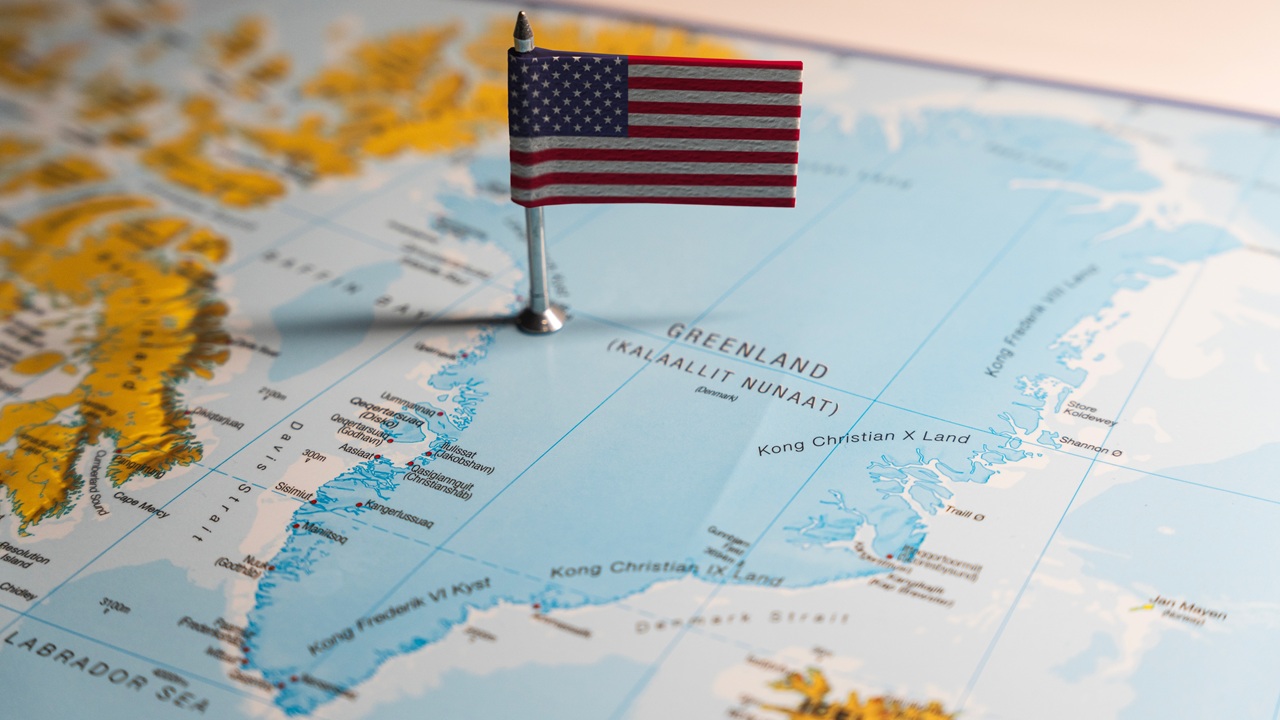
In recent weeks, global public attention has been focused on several important events. The first, naturally, was the latest session of the United Nations General Assembly in New York, where world leaders gathered to discuss the most pressing issues concerning global peace, the economy, trade, and other matters. The second was undoubtedly the bilateral meeting between Trump and Xi Jinping, which was marked by unprecedented protocol arrangements, an extensive agenda, and a US-style public relations campaign aimed at both domestic and international audiences. However, regardless of the hectic developments at the UN and the US–China summit, another event took place that deserves separate consideration, both in terms of global security and economic developments and in the context of US–China competition. Notably, news of this event emerged just days before the high-level negotiations between theUnited States and the People’s Republic of China.
The Greenland Dilemma
One of the most important developments of the previous week, and one that has been discussed extensively and willlikely remain a subject of debate for a long time, was the historic agreement concluded between the United States, theKingdom of Denmark, and Greenland. The agreement is of historic significance not only for the future of the island and the role and importance of theKingdom of Denmark in the 21st century, but also for US foreign policy, global competition, the transatlantic securityarchitecture, and the broader process of reallocating global resources. It is noteworthy that Greenland had been a key issue under consideration by the Trump administration for quite sometime. Immediately after taking office, Trump began exerting considerable pressure on the Kingdom of Denmark andGreenland, openly declaring his ambitions, aspirations, and intentions regarding the island, given its strategic location and substantial mineral resources. Trump’s pressure tactics and statements couched in the language of coercion and blackmail naturally provoked considerable discontent, not only in Denmark but also across the European Union and among other NATO member states that are strategic allies of the United States but do not share Trump’s aggressive approach. On September 22, the United States, Denmark, and Greenland signed a historic agreement granting the United States an exceptional role and specific rights concerning the island, particularly with regard to the deployment of security and military infrastructure and the use of its resources.
Specifically, the agreement clearly provides for the following:
1. The right to expand and modernize the Pituffik Space Base: The United States may expand its military activities at the existing base.
2. The right to establish new defense zones: These may be established in the Narsarsuaq and Mestervig areas, as well as in other parts of Greenland in the future, subject to procedures agreed upon by the parties.
3. Unrestricted military access and movement across Greenland: US military vessels, aircraft, armed forces, and transport vehicles would be granted access by land, air, and sea.
4. Broad rights to conduct flights across Greenland and navigate its territorial waters: US aircraft may fly over and land in any part of Greenland, while US government vessels may enter and navigate its territorial waters under the conditions stipulated in the agreement.
5. A long-term or indefinite US military presence: The agreement has no fixed expiration date and provides for its continued operation even if Greenland becomes independent in the future, provided that the newly established state assumes the rights and obligations stipulated in the agreement.
Beyond these provisions, there is another important aspect that warrants attention: the island’s critical minerals and natural resources. The agreement itself does not transfer control over these resources to the United States, nor does it explicitly provide for such a transfer. Nevertheless, several details deserve closer examination. First, the parties agree that states that are not NATO members, NATO partners, or members of the European Union—and investors from such states—should not be permitted to exercise control or significant influence over sensitive sectors or activities in Greenland, or to gain access to non-public information in those areas, where such involvement could pose a threat to national security or public order. This is, in fact, a rather ambiguous provision that leaves considerable room for interpretation. It is evident that theUnited States will not allow any rival power to establish a foothold in these sectors. The agreement’s duration is also significant. In particular, it has no fixed term and will remain in force even ifGreenland decides to gain independence from Denmark and becomes an independent subject of international law.
China’s Ambitions in Greenland
Why is China’s role in Greenland so important, and why was the United States in such a hurry to address the issue? For years, China had been taking several important and deliberate steps to expand its presence in Greenland. Beijing had begun expressing interest in the same critical minerals and natural resources, while already wielding influence, through various means, over a substantial share of global reserves. At the same time, Beijing was paying close attention to Greenland’s position as a geopolitical and economic factor. First, China has positioned itself as a near-Arctic state, using this designation to advance its concept of a Polar SilkRoad. Although the Northern Sea Route along Russia’s Arctic coastline is currently important to Beijing, this does not diminish Greenland’s significance for China. Chinese companies had expressed a clear interest in Greenland’s airports, but encountered certain obstacles in recent years, and those efforts failed to make progress. Another important area of interest involved Arctic scientific and educational initiatives. Here, too, Greenland held considerable importance because of its geopolitical location. Consequently, China was interested in Greenland’s mineral resources, supply chains, infrastructure, scientific research, and long-term geopolitical presence. Situated between Europe and the United States, the island possesses unmistakable geopolitical and strategic significance. Given these circumstances, it was becoming increasingly apparent that, over time, China could use large-scale and aggressive investment to effectively absorb Greenland into its economic orbit, eventually becoming the island’s principal investor and trading partner. For the United States, therefore, this move was part of a carefully planned and calculated strategy that the administration had been pursuing since the very beginning of its return to power.
As for Denmark, the kingdom had more to gain from Greenland becoming dependent on its ally, the United States, in matters of security, economic security, and investment than from becoming independent or dependent on China. This was particularly true given the potential scenarios that could emerge from Chinese economic expansion. Most likely, policymakers in Copenhagen understood that Denmark in the 21st century was no longer the Denmark of the 18th century. The aggressive competition of the modern world would not allow an island as rich in resources and as geographically and geopolitically significant as Greenland to remain untouched by external powers’ influence and ambitions. Consequently, the partial relinquishment of Copenhagen’s influence and jurisdiction over the island was only a matter of time and eventuality that, sooner or later, was bound to arise.
Originally published by Luys Foundation
